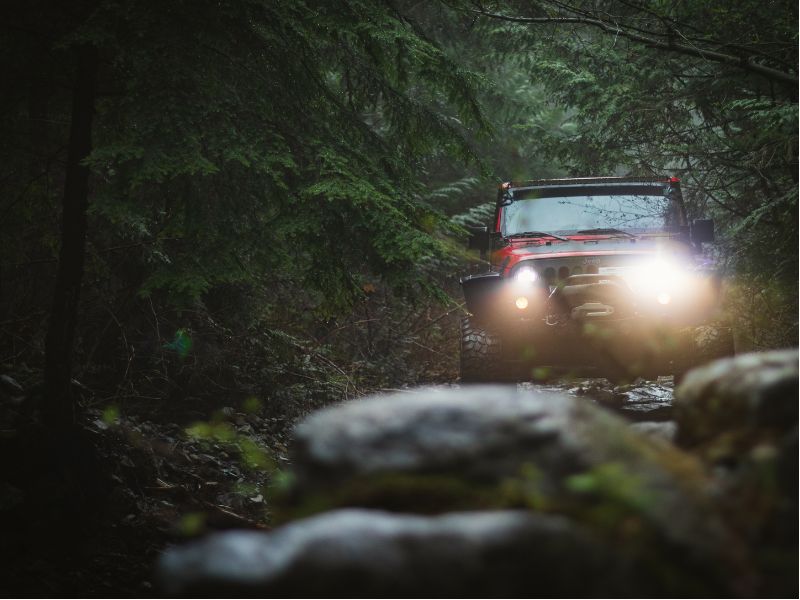
You want to drive your vehicle somewhere most people can’t. Through the desert, over a mountain pass, into a canyon where the pavement ends. That’s the dream. The reality is that a poorly planned off-road trip turns into a survival story nobody wants to hear. This guide cuts the fluff and tells you exactly what you need to plan a trip that’s fun, not fatal.
1. Match Your Vehicle to the Terrain — Don’t Lie to Yourself
Your Subaru Outback is not a Jeep Wrangler Rubicon. Accept that now. The biggest mistake people make is taking a vehicle into terrain it wasn’t built for. A stock Ford Escape on all-season tires will not handle the Rubicon Trail. Period.
Here’s the real breakdown of what different vehicles can handle:
| Terrain Type | Minimum Vehicle Requirement | Example Vehicle |
|---|---|---|
| Graded gravel/dirt roads | Any AWD with 8″ ground clearance | Subaru Outback Wilderness |
| Rocky two-tracks, mild ruts | 4×4 with low range, 10″ clearance | Toyota 4Runner TRD Off-Road |
| Deep sand, mud, steep climbs | 4×4 with locking diffs, 12″+ clearance | Jeep Wrangler Rubicon |
| Extreme rock crawling | Modified vehicle with 35″+ tires, solid axles | Jeep Wrangler on 37s |
If you don’t own a 4×4, rent one. Companies like Offroad Rentals in Moab or Tucson will set you up with a built Jeep Gladiator for around $250/day. That’s cheaper than replacing your transmission after one bad day on Fins and Things.
The second mistake is ignoring tire condition. Your tires are the only thing touching the ground. If they’re worn below 6/32″ tread, replace them before you go. BFGoodrich KO2s or Falken Wildpeak AT3Ws are the standard for mixed terrain. Budget $200-400 per tire.
2. Your Route Must Be Researched — Not Just Picked on a Map
Picking a random trail on Google Maps is how you end up stuck on a washed-out shelf road at 10 PM with no cell service. You need three things before you turn a wheel: a digital route file, a paper backup, and a current trail report.
Use apps like Gaia GPS ($50/year) or OnX Offroad ($30/year) to download the route. Both show trail difficulty ratings, current closures, and user photos. Download the map for offline use. You will lose signal in canyons.
Before you go, check the land management agency’s website. The BLM, USFS, and state parks all post closures. A trail that was open in May might be closed in June due to snow or fire. Call the local ranger station. They know the real conditions.
Plan your daily mileage realistically. On pavement, you can cover 300 miles easily. On a rocky trail, you’ll be lucky to do 20 miles in 8 hours. Plan for 10 miles of trail per hour of driving. That’s the real number.
What to do when the trail is harder than expected
Turn around. Seriously. Pride is the #1 reason people get stuck. If you hit a section that looks sketchy, stop, get out, and walk it. If you wouldn’t drive it on pavement at 5 mph, don’t drive it here. Back up to a safe spot and find another way.
3. The Gear You Actually Need — Not the Gear You Want
Most people pack too much crap. You don’t need a rooftop tent for a weekend trip. You need reliable recovery gear, water, and a way to call for help. Everything else is comfort.
Here’s the non-negotiable list for any off-road trip longer than one day:
- Recovery boards — Maxtrax MKII ($300) are the gold standard. Cheap knockoffs snap under load. Don’t risk it.
- Air compressor — Viair 88P ($80) plugs into your 12V port. Air down to 15-20 psi on sand, air back up for pavement. This alone prevents 90% of getting stuck.
- Tire repair kit — ARB Speed Seal kit ($40) plus a plug tool. Know how to use it before you leave.
- First aid kit — Adventure Medical Kits Sportsman ($50). Add a tourniquet and chest seal. Trauma is real on remote trails.
- Communication device — Garmin inReach Mini 2 ($400 + $12/month). It texts via satellite. No cell service required. This is your lifeline.
- Water — 1 gallon per person per day minimum. Double it if you’re in the desert. A 5-gallon Scepter water can ($45) is bombproof.
That’s it. That’s the core list. Everything else — fridge, stove, camp chairs — is optional. If you can’t afford the inReach, you can’t afford the trip. End of story.
4. Food and Water — The Part Everyone Gets Wrong
You can’t just throw granola bars in a bag and call it good. Off-road driving burns 2-3 times the calories of highway driving. Your body needs real food and lots of water.
Plan for 4,000 calories per person per day. That sounds like a lot because it is. You’ll be cold at night, hot during the day, and working harder than you think. Dehydration is the most common reason trips get cut short. If your urine is dark yellow, you’re already behind.
Pack food that doesn’t need refrigeration unless you have a proper 12V fridge. The ARB 50-quart fridge ($900) is the industry standard. It draws 2.5 amps and keeps food cold at 34°F even in 100°F heat. If you can’t afford that, use a high-quality cooler. The Yeti Tundra 45 ($350) holds ice for 5 days if you pre-chill it and don’t open it every 10 minutes.
Meal examples that work:
- Breakfast: instant oatmeal with powdered milk and nuts (add boiling water)
- Lunch: tortillas with shelf-stable peanut butter and honey
- Dinner: freeze-dried meals from Mountain House ($10 each) — the Beef Stroganoff is actually good
- Snacks: trail mix, beef jerky, electrolyte tablets (Nuun or Liquid IV)
Store all food in a bear-proof container if you’re in bear country. A BearVault BV500 ($85) holds 5 days of food for one person. Raccoons will open a regular cooler. Trust me.
5. Navigation That Doesn’t Fail When You Need It Most
Your phone is not a navigation device for off-road travel. It’s a backup. The primary system should be a dedicated GPS or a tablet running offline maps.
The best setup right now is an iPad Mini (6th gen) ($500) with cellular (for the GPS chip, not for data) running Gaia GPS. Mount it on the dash with a RAM mount ($60). The screen is large enough to see trail details, and the battery lasts 8 hours of continuous use. Pair it with a 12V charger.
Always carry a paper map of the area. The USGS 7.5-minute topographic maps ($8 each) show every gully and ridge. Mark your route with a highlighter. If your tablet dies, you still have the map and a compass. You do know how to read a compass, right?
One more thing: tell someone your exact route and expected return time. Not “I’m going to Moab.” Send them a screenshot of your Gaia route with waypoints. If you don’t check in by 6 PM, they call search and rescue. The Garmin inReach also has a check-in feature — use it.
6. The Biggest Mistake: Overconfidence and No Backup Plan
There’s a reason experienced overlanders carry two spare tires and a full tool kit. Things break. You will get a flat. You might break a control arm. You might slide into a ditch and need a winch.
Before you leave, do a full vehicle inspection. Check belts, hoses, fluids, brakes, and suspension. If you don’t know how, pay a shop. A $200 inspection is cheaper than a $2,000 tow from a trailhead.
Carry tools. At minimum: a socket set (metric and SAE), a torque wrench, a breaker bar, a jack that actually works (the factory scissor jack is garbage — get a Hi-Lift Jack for $100), and a tire plug kit.
Practice recovery before you need it. Go to a flat dirt lot and use your Maxtrax and air compressor. Learn how to winch safely. A winch cable under tension can kill you if it snaps. Put a weighted blanket or a winch damper over the cable. The Factor 55 FlatLink ($85) is the safest way to connect a winch line.
If you’re traveling alone, double your safety margin. No solo trips on trails rated 7 or higher on OnX. Bring a satellite messenger. Tell someone where you are every day. Solo off-roading is not a flex. It’s a risk calculation. Do the math honestly.
7. When You Should Not Go Off-Road at All
This is the honest part. Off-road travel is not for everyone, and not for every vacation. If any of these apply to you, reconsider:
- You have a brand-new vehicle you’re afraid to scratch.
- You don’t have basic mechanical knowledge (changing a tire, checking oil).
- You’re on a tight schedule with no buffer days.
- You’re traveling with someone who can’t handle 6 hours of bumpy, slow driving.
- You can’t afford proper recovery gear and a satellite communicator.
There is no shame in renting a cabin and taking a guided jeep tour instead. Companies like Moab Adventure Center offer half-day tours in a Jeep Wrangler for $150 per person. You get the views and the adrenaline without the risk. That’s a smart choice for most people.
Off-road travel is about self-reliance and respect for the environment and your own limits. If you’re not ready for that, stay on pavement. The trails will still be there next year.
The single most important takeaway: Plan your trip around your recovery capability, not your driving ambition.