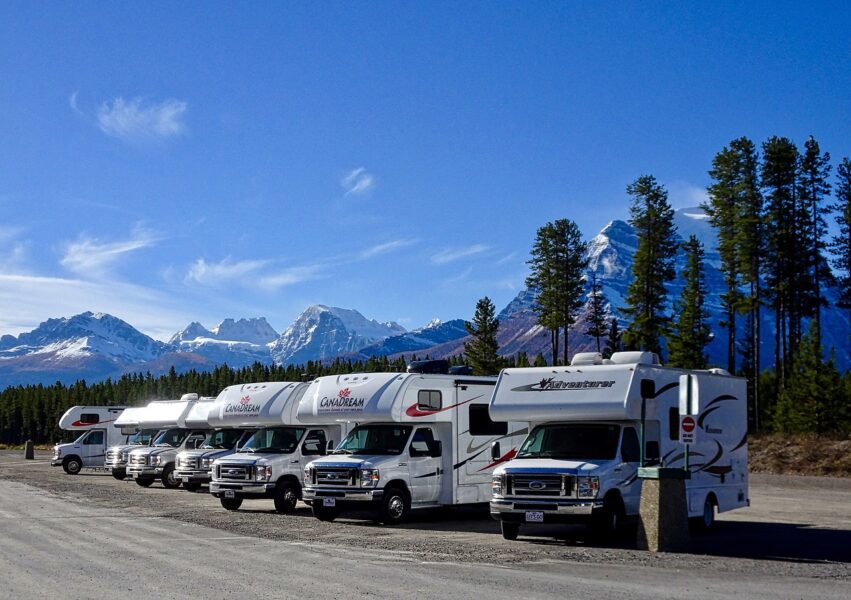
You reserved a 27-foot Thor Motor Coach for two weeks through the Southwest. The rental cost $2,400, plus a $1,500 deposit. You’re excited. But on day two, you realize the generator burns through 3 gallons of gas in four hours of A/C use. By day five, you’ve paid $180 in unexpected fuel charges. You’re not alone — this is the most common budgeting blind spot for new RVers.
1. Underestimating Total Trip Costs by 40% or More
Most first-timers budget for the rental fee and campsite fees. They forget everything else.
Fuel: The Real Number
A Class C RV like the Thor Motor Coach Chateau 22E gets 8–10 mpg on flat highway. That’s $0.35–$0.50 per mile at current gas prices ($3.50/gal). A 1,500-mile trip costs $525–$750 in fuel alone. Your rental company will tell you “about 10 mpg.” That’s optimistic with A/C running and hills.
Generator Fuel Burn
Running the onboard generator (typically a 4,000-watt Onan) to power the roof A/C uses 0.5–0.8 gallons of gas per hour. At $3.50/gal, that’s $1.75–$2.80 per hour of cool air. Eight hours overnight = $14–$22 extra per night. Do that for 10 nights and you’ve added $140–$220 to your fuel bill.
Hidden Fees
Rental companies often charge for mileage over a daily limit (e.g., 100 miles/day). Overages run $0.35–$0.50 per mile. Cleaning fees: $150–$300 if you return the RV dirty. Propane refill: $25–$40 if you empty the tank. Dumping fees: $10–$20 if you skip the free dump station at the campsite.
| Expense Category | Estimated Cost (1,500-mile trip, 10 nights) |
|---|---|
| RV rental (Class C, 27ft) | $2,400 |
| Fuel (RV) | $525–$750 |
| Generator fuel (8 hrs/night) | $140–$220 |
| Campsite fees (average $45/night) | $450 |
| Propane refill (1 tank) | $25–$40 |
| Cleaning/dump fees (if not DIY) | $160–$320 |
| Total realistic cost | $3,700–$4,180 |
Budget 40% more than the rental fee. That $2,400 rental is actually a $3,700 trip. Plan accordingly.
2. Ignoring the Weight Limit — and Paying the Price
RVs have a Gross Vehicle Weight Rating (GVWR). Exceed it, and you risk tire blowouts, brake failure, and a voided rental contract.
What Most People Overlook
Water weighs 8.34 lbs per gallon. A full fresh water tank (40 gallons) adds 334 lbs. A full gray tank (30 gallons) adds 250 lbs. A full black tank (25 gallons) adds 208 lbs. That’s nearly 800 lbs of water weight alone. Add 200 lbs of food, 150 lbs of gear, 100 lbs of bikes, and four people averaging 175 lbs each (700 lbs total). You’re at 1,950 lbs of payload. Many Class C RVs have a payload capacity of only 1,500–2,000 lbs. You’re over before you start the engine.
How to Avoid It
Find the GVWR sticker inside the driver’s door. Subtract the RV’s curb weight (from the manufacturer spec sheet). That’s your payload. Then weigh everything you pack on a bathroom scale. Seriously. A Etekcity digital luggage scale ($12) can save you from a $500 tire replacement bill.
3. Booking the Wrong Campsite Type
Not all campsites are created equal. First-timers often book the cheapest site without checking hookups, length limits, and generator rules.
Full Hookups vs. Partial vs. Dry
Full hookup sites (water, electric, sewer) cost $50–$80/night at private RV parks like KOA or Jellystone. You can run the A/C on shore power (no generator noise or fuel cost). You can dump tanks without moving. Worth the premium.
Partial hookup (electric only) saves $10–$20/night but you’ll need to use the campground’s dump station (often a line on Sunday morning).
Dry camping (no hookups) costs $10–$25/night in national forests or BLM land. You rely entirely on battery, generator, and water tank. If you choose this, you need a quiet generator (Honda EU2200i, $1,200) or you’ll annoy every neighbor within 200 feet. Many campgrounds ban generator use after 8 PM or before 8 AM.
Length Restrictions
State parks often have 25-foot or 30-foot maximum site lengths. A 27-foot RV with a 5-foot hitch rack for bikes won’t fit. Measure your total length (bumper to bumper, including bike rack) before booking. Reserve America and Recreation.gov list site lengths. Filter by “RV length.”
4. Not Testing Every System Before You Leave the Lot
You’ll discover problems on the road — when fixing them is expensive and time-consuming.
Test these before you sign the rental contract:
- Air conditioner: Turn it on, set to 60°F, wait 10 minutes. Feel cold air? Good. If it blows warm, the unit needs service.
- Refrigerator: Switch to propane mode (for travel). The fridge should cool to 40°F within 2 hours. If it stays at 50°F, your food spoils.
- Water pump: Fill the fresh tank, turn on the pump, open every faucet. Listen for sputtering (air in lines) or leaks under the sink.
- Generator: Start it, let it run 15 minutes with the A/C on. Check the fuel gauge — if it drops fast, the generator is inefficient or the fuel tank is smaller than stated.
- Slide-outs: Extend and retract each one three times. If it stutters or stops, the mechanism is failing. A stuck slide-out means you can’t use half the RV.
- Propane system: Light the stove and oven. If the flame is yellow instead of blue, the regulator or burner needs cleaning.
Take a video of the walkthrough. If something breaks, you have proof it was pre-existing. Rental companies will try to charge you for damage that was already there.
5. Overpacking (And Not Packing the Right Things)
RV storage is limited. A 27-foot RV has about 60 cubic feet of exterior storage — less than a small pickup truck bed. You cannot bring everything.
What to Leave at Home
Heavy cast iron cookware (use lightweight stainless steel or non-stick). Extra chairs (two folding chairs per person max). Full-sized towels (use quick-dry microfiber — Rainleaf microfiber towels ($15 each) dry in 2 hours vs. 8 hours for cotton). Board games with 50 pieces (bring a deck of cards and a Kindle).
What to Bring That You Forgot
A 50-foot drinking water hose (the standard 25-foot hose won’t reach many sites). A 30-amp to 15-amp adapter plug ($12) for older campgrounds. A surge protector (Progressive Industries EMS-PT30X, $140) to protect your RV’s electronics from power spikes. A leveling block set (Lippert SolidStep, $40) — most campsites are not level. A portable tire inflator (Viair 88P, $50) — RV tires lose pressure on hot pavement.
The One-Hour Rule
If you haven’t used an item in the first hour of packing, leave it. You won’t miss it. You will regret the extra 50 lbs of “just in case” gear.
6. Driving Like a Car (Instead of a House on Wheels)
An RV handles nothing like your sedan. The turning radius is wider, the braking distance is longer, and wind pushes you around.
Speed Limits and Fuel Economy
Most RVs have a maximum safe speed of 65 mph. Tire ratings (typically L or M speed rating) are only certified up to that speed. At 70 mph, your fuel economy drops from 10 mpg to 7 mpg — that’s an extra $150 on a 1,500-mile trip. At 75 mph, you risk a blowout. Set the cruise control at 60–62 mph. You’ll arrive 20 minutes later and save $100+.
Braking Distance
A loaded 27-foot Class C RV weighs about 12,000 lbs. At 60 mph, stopping distance is 250–300 feet on dry pavement — about the length of a football field. Double the following distance you use in a car. If the car in front of you brakes hard, you cannot stop in time.
Wind and Passing Trucks
Crosswinds push a boxy RV sideways. When a semi passes you at 70 mph, the air pressure can shove you into the next lane. Grip the wheel firmly, slow to 55 mph, and do not overcorrect. If you feel the RV swaying, you’re going too fast.
7. Skipping the Pre-Trip Test Drive and Parking Practice
Driving an RV for the first time on a mountain highway is a recipe for panic. Parking it in a tight campsite with an audience is worse.
Test Drive Requirements
Before you leave the rental lot, drive the RV on a highway at 55 mph for at least 20 minutes. Practice lane changes, merging, and braking from 60 mph. If the RV pulls to one side, the alignment is off. If the steering wheel shakes, the tires are unbalanced. Both are safety issues the rental company should fix before you go.
Backing Up and Parking
Find an empty parking lot (a Walmart or school on Sunday). Set up two traffic cones 12 feet apart — that’s the width of a typical campsite. Practice backing the RV between them. Use your side mirrors, not the backup camera (the camera has a wide-angle lens that distorts distance). Do this for 30 minutes. You will still scrape a bush at your first campsite. That’s normal. The cones help you avoid scraping the neighbor’s $80,000 motorhome.
Leveling Without Blocks
If you don’t have leveling blocks, you can use 2×8 lumber scraps from a hardware store ($5 each). Cut them into 12-inch lengths. Stack two under the low-side tires. Test with a bubble level on the countertop. If the RV is more than 3 degrees off level, the refrigerator won’t cool properly (the ammonia solution pools in the wrong place).
The Bottom Line on First-Time RV Trips
Most first-timers spend 40% more than they budgeted, overload the RV by 500+ lbs, and book sites that don’t fit their rig. Avoid those three mistakes and your trip will be smoother than 90% of new RVers.
The single best piece of advice: rent a smaller RV than you think you need. A 22-foot Class C (like the Thor Four Winds 22E) is easier to drive, park, and fuel than a 30-foot model. It fits in more campsites. It costs less to rent and fuel. You lose 4 feet of living space, but you gain peace of mind. That’s worth more than a bigger sofa.